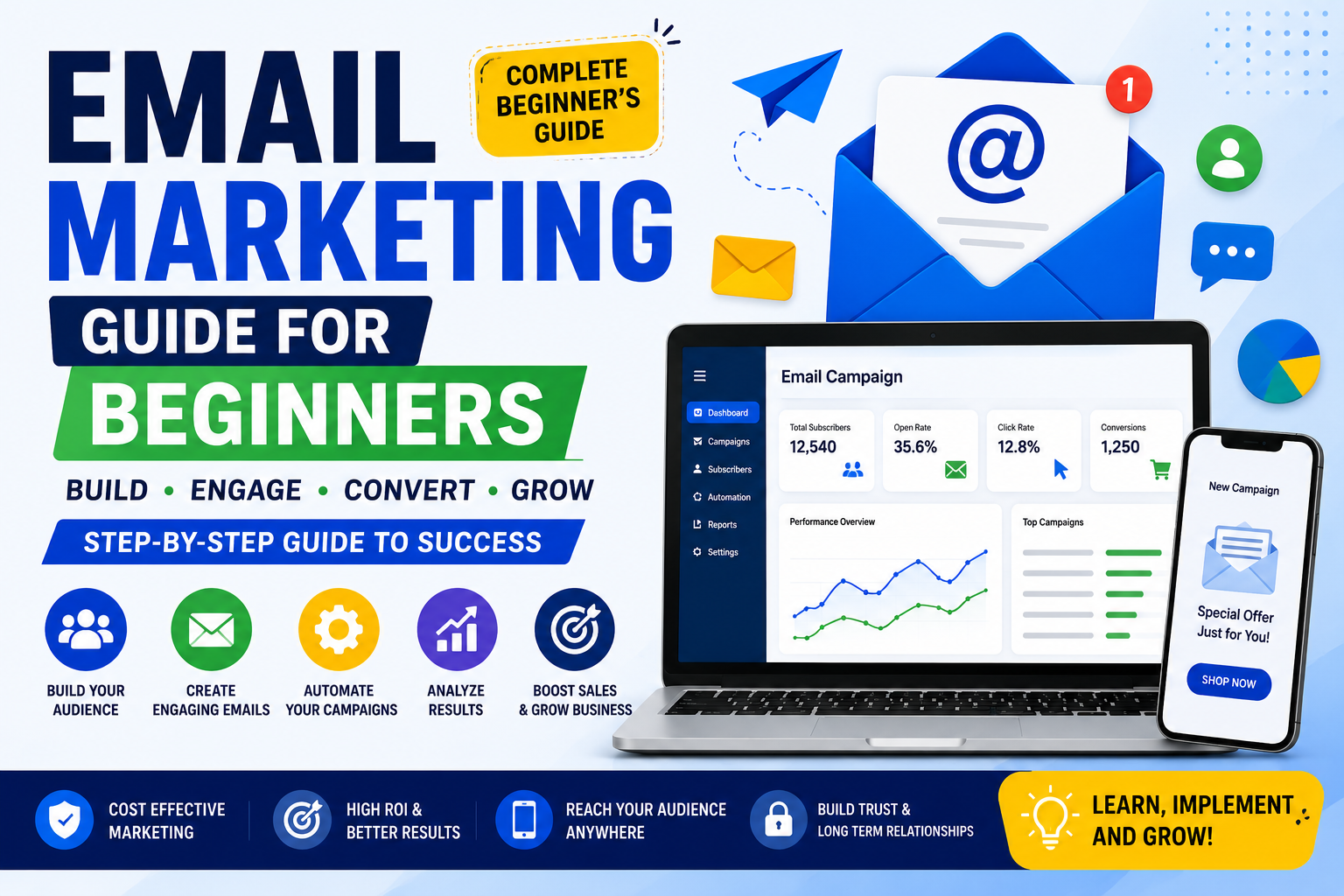
Email Marketing Guide for Beginners (2026): The Complete Step-by-Step Guide
Introduction
In today’s digital world, email remains one of the most powerful and cost-effective marketing channels for businesses of all sizes. Despite the rise of social media and messaging apps, email marketing continues to deliver one of the highest returns on investment (ROI) in digital marketing.
Email marketing allows businesses to communicate directly with customers, promote products and services, build relationships, increase sales, and improve customer loyalty.
Whether you are a blogger, freelancer, small business owner, online store owner, or digital marketer, learning email marketing can help you grow your audience and achieve your business goals.
This beginner-friendly guide explains everything you need to know about email marketing, including its benefits, strategies, tools, email list building, campaign creation, automation, and best practices.
What is Email Marketing?
Email marketing is a digital marketing strategy that involves sending emails to subscribers, customers, or potential clients to promote products, services, content, or brand awareness.
Businesses use email marketing to:
- Build customer relationships
- Increase website traffic
- Promote products and services
- Generate leads and sales
- Share updates and announcements
- Improve customer retention
Email marketing is considered an “owned marketing channel” because businesses communicate directly with subscribers without depending entirely on social media algorithms.
Why is Email Marketing Important?
Email marketing remains one of the most effective online marketing methods because:
Direct Communication
Email allows businesses to communicate directly with customers in their inbox.
High Return on Investment (ROI)
Email marketing often generates better returns than many other digital marketing channels.
Cost-Effective Marketing
Starting email marketing is affordable, making it ideal for beginners and small businesses.
Better Customer Relationships
Regular communication builds trust and long-term relationships.
Increased Sales Opportunities
Targeted emails can encourage purchases and repeat business.
Full Ownership of Your Audience
Unlike social media followers, your email list belongs to your business.
Benefits of Email Marketing
1. Builds Brand Awareness
Regular emails keep your brand in front of your audience.
2. Generates Website Traffic
Email campaigns can drive visitors to blog posts, products, and landing pages.
3. Improves Customer Engagement
Subscribers can interact with your content through clicks and replies.
4. Increases Sales
Promotional campaigns can generate significant revenue.
5. Encourages Repeat Purchases
Email helps retain existing customers.
6. Supports Business Growth
A quality email list becomes a valuable business asset.
How Email Marketing Works
The email marketing process generally follows these steps:
- Create an email list.
- Collect subscriber information.
- Segment your audience.
- Create valuable content.
- Design email campaigns.
- Send emails.
- Analyze results.
- Optimize future campaigns.
Types of Email Marketing Campaigns
Welcome Emails
Sent when someone joins your email list.
Example:
“Thank you for subscribing to our newsletter.”
Newsletter Emails
Used to share:
- Articles
- Updates
- Industry news
- Tips and tutorials
Promotional Emails
Used to promote:
- Products
- Services
- Discounts
- Special offers
Educational Emails
Provide:
- Guides
- Tutorials
- Helpful resources
Transactional Emails
Examples:
- Order confirmations
- Password resets
- Payment receipts
Re-engagement Emails
Sent to inactive subscribers.
Example:
“We miss you! Here’s what’s new.”
Email Marketing Terminology Every Beginner Should Know
Subscriber
A person who joins your email list.
Email List
A collection of subscriber email addresses.
Open Rate
Percentage of subscribers who open your email.
Click-Through Rate (CTR)
Percentage of subscribers who click links inside emails.
Conversion Rate
Percentage of subscribers who complete desired actions.
Bounce Rate
Percentage of emails that fail to reach recipients.
Unsubscribe Rate
Percentage of users who leave your email list.
Why Businesses Use Email Marketing
Businesses use email marketing to:
- Build trust
- Generate leads
- Increase sales
- Improve customer loyalty
- Share educational content
- Promote products and services
- Build communities
How to Build an Email List
Create Valuable Content
People subscribe when they receive useful information.
Offer Free Resources
Examples:
- E-books
- Guides
- Checklists
- Templates
Use Signup Forms
Add forms to:
- Homepage
- Blog posts
- Sidebar
- Footer
Use Pop-Ups Carefully
Well-designed pop-ups can increase subscriptions.
Email Marketing Platforms for Beginners
Mailchimp
Advantages:
- Beginner friendly
- Free plan available
- Automation tools
Brevo (Formerly Sendinblue)
Advantages:
- Affordable
- SMS marketing support
- Automation features
MailerLite
Advantages:
- Easy interface
- Great for bloggers
- Automation support
ConvertKit
Advantages:
- Excellent for creators
- Easy email sequences
- Landing page builder
GetResponse
Advantages:
- Marketing automation
- Webinars
- Advanced features
How to Create Your First Email Campaign
Step 1: Define Your Goal
Examples:
- Increase sales
- Generate traffic
- Promote content
- Build engagement
Step 2: Choose Your Audience
Target:
- New subscribers
- Existing customers
- Potential buyers
Step 3: Write an Engaging Subject Line
Examples:
- Beginner’s Guide to Email Marketing
- Free Marketing Tips for Small Businesses
- Learn Email Marketing Step by Step
Step 4: Create Valuable Content
Provide:
- Helpful information
- Practical solutions
- Useful resources
Step 5: Add Call-to-Action (CTA)
Examples:
- Read More
- Download Guide
- Visit Website
- Learn More
Email Writing Best Practices
Keep Emails Short
Write Clearly
Use Professional Language
Personalize Messages
Focus on Value
Include Clear Calls-to-Action
Email Marketing Automation
Automation allows businesses to send emails automatically.
Examples:
- Welcome emails
- Follow-up emails
- Abandoned cart emails
- Birthday emails
Benefits:
- Saves time
- Improves consistency
- Increases engagement
Common Email Marketing Mistakes
- Buying email lists
- Sending too many emails
- Ignoring mobile optimization
- Using misleading subject lines
- Not testing campaigns
- Ignoring analytics
Email Marketing Metrics to Track
Open Rate
Measures how many people open emails.
Click-Through Rate (CTR)
Measures engagement.
Conversion Rate
Measures results.
Bounce Rate
Measures deliverability issues.
Unsubscribe Rate
Measures subscriber satisfaction.
Email Marketing Tips for Beginners
- Build your own email list.
- Provide value first.
- Write compelling subject lines.
- Keep designs simple.
- Optimize for mobile devices.
- Test different strategies.
- Monitor campaign performance.
- Stay consistent.
- Respect subscriber privacy.
- Focus on long-term relationships.
Frequently Asked Questions (FAQs)
Is email marketing still effective in 2026?
Yes. Email marketing remains one of the most effective digital marketing channels.
Is email marketing free?
Many platforms offer free plans for beginners.
How often should I send emails?
Consistency is important. Weekly or bi-weekly schedules often work well.
Can small businesses benefit from email marketing?
Absolutely. Email marketing is suitable for businesses of all sizes.
Is buying email lists recommended?
No. Building your own email list is considered best practice.
Final Thoughts
Email marketing is one of the most valuable skills in digital marketing. It helps businesses communicate directly with their audience, build relationships, generate leads, and increase sales.
For beginners, the key to successful email marketing is simple:
- Build an authentic email list.
- Provide valuable content.
- Communicate consistently.
- Focus on trust and relationships.
- Analyze results and continuously improve.
By learning and applying the principles in this guide, beginners can build effective email marketing campaigns and create long-term business growth opportunities.